|

 November 26 , 1999 November 26 , 1999
Pastor defrocked for same-sex holy union rite
>> CONTINUED >>
Although the church�s high court ruled in August 1998 that the Social Principals could be enforced, enough jurors in Creech�s first trial were swayed by the controversy to acquit him.
One month later, in April 1998, Creech performed the ceremony that resulted in the second trial. For the second trial, Creech chose to refuse counsel, and not participate in jury selection or cross-examine witnesses.
"To put on a defense will give credibility to the law and will say the law is valid and just," Creech said. "I will not give any credibility to the law."
Creech did testify in response to questions and gave a closing statement, which he used to present evidence that the ban on same-sex unions harms the church and conflicts with the teachings of Jesus.
When asked, Creech said that he considers the union between the two men to be a marriage. In response to a juror�s question about whether he will continue to perform unions for same-sex couples, Creech replied, "There is nothing that will deter me from doing that."
"This is truly a sad day in the history of the United Methodist Church," Creech told the jurors. "This trial is an act of violence against gay, lesbian, bisexual, and transgender people."
The night before the trial was scheduled to begin, Creech co-officiated a re-commitment ceremony for the two men he married in April, using the same liturgy as the original ceremony.
After the ceremony, Soulforce members took turns to keep an all-night vigil on the steps of the church hosting the trial.
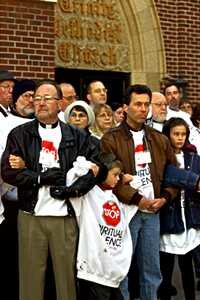 The entire Soulforce group gathered outside the church at 7:00 am on the morning of the trial, and 74 locked arms momentarily when the jurors arrived, blocking the entrance. Those 74 were arrested and charged with second degree misdemeanor trespassing, and were released after paying a fine and legal fees totaling $48. The entire Soulforce group gathered outside the church at 7:00 am on the morning of the trial, and 74 locked arms momentarily when the jurors arrived, blocking the entrance. Those 74 were arrested and charged with second degree misdemeanor trespassing, and were released after paying a fine and legal fees totaling $48.
Two children who locked arms with protesters blocking the church entrance were not arrested because of their age, but stayed with the other protesters during the arrest, singing "We Shall Overcome" as police wrote tickets and assessed fines.
Protesters hoped to persuade church jury members to refuse to participate in the trial, either by not entering the church where the trial was held, or by rendering no verdict. Many were shocked when the jury returned its guilty verdict at 1:35 pm on the first day of the trial, which was scheduled to last two days.
When the jury announced its decision to remove Creech�s ministerial credentials, several cried.
The Rev. Mel White, co-founder of Soulforce, said that it is very rare for a United Methodist minister to be defrocked.
"If it�s ever done, it�s for impropriety, either financial or sexual. Jimmy not only paid a penalty, but he was put into a special class, like Jesus was." White said. "It was an excessive penalty. They not only punished him, they punished him as a criminal."
"The penalty is a harsh one," Creech told reporters after the sentence was announced. "I feel the loss severely. But that doesn�t compare to what gay, lesbian, bisexual and transgendered people must feel. The church has said it will use its power, legal power, spiritual power and financial power, to enforce bigotry. It�s a sad day. It�s a scandalous day for the United Methodist Church."
A coalition of five United Methodist groups supporting Creech issued a statement after the trial calling it "a travesty of justice and a violation of the integrity of the ministry of the church."
The groups vowed to take action against the United Methodist ban on same-sex unions during the church�s annual conference in May, which will take place in Cleveland.
"I believe when we get to General Conference," Dell said, "delegates will say that they will reclaim our heritage of grace in the midst of differences."

Cruising man assaulted in supermarket parking lot
by Denny Sampson
Gay People's Chronicle
November 26, 1999
Cleveland--Two young men robbed and physically assaulted a gay man in a Cleveland grocery store parking lot early in the morning on November 11.
The attack occurred at 3 am in Giant Eagle�s (formerly Rini Rego�s) parking lot at West 117th St. and Clifton Blvd.
 "I was there cruising," said the victim, Edward Pugh of Lakewood. "Two young guys drove up and acted like they wanted to talk, at first. Then they pulled their car behind me so I couldn�t move my car. One had a hammer, the other had a large flashlight They asked me for my wallet, and busted my car window. Then one of them hit me in the head with the hammer several times. I gave them my wallet." "I was there cruising," said the victim, Edward Pugh of Lakewood. "Two young guys drove up and acted like they wanted to talk, at first. Then they pulled their car behind me so I couldn�t move my car. One had a hammer, the other had a large flashlight They asked me for my wallet, and busted my car window. Then one of them hit me in the head with the hammer several times. I gave them my wallet."
The two assailants were reportedly Caucasian, between the ages of 20 and 25.
"When they left, I ran over to the CVS [pharmacy] across the street for help," Pugh said. "The ladies there were very helpful, and convinced me to go to Lakewood Hospital for treatment. The nurse called the police at the [First District] in Cleveland, and she asked them to send an officer to the hospital."
Pugh described the policeman who came to the hospital to take his statement as "very rude."
"He said it (the attack) was my fault for being there. He acted like he didn�t want to take the report, and only took it because I insisted."
Pugh was also dissatisfied by his treatment from the emergency room doctor. "He just gave me aspirin. I had been beaten in the head with a hammer, and he never even took X-rays."
"I am making my story public so that maybe I can prevent someone else from going through what I went through," said Pugh.
Pennsylvania bans university same-sex benefits
by Denny Sampson
Gay People's Chronicle
November 26, 1999
Harrisburg, Pa.-Pennsylvania lawmakers quickly approved legislation that bans domestic partnership health benefits for employees of state-financed colleges and universities.
The measure also exempts colleges and universities from providing same-sex benefits in cities where local ordinances require such benefits be provided.
In two unscheduled votes on an amendment to a completely unrelated bill, both the Pennsylvania House and Senate passed the measure on Tuesday, November 16.
A spokesman for Gov. Tom Ridge's office said he intends to sign the bill into law.
"The governor believes marriage is a heterosexual institution," said Tim Reeves, Ridge�s spokesman. "We see what�s happening in Pittsburgh as an [intrusion] on the institution of marriage. State employees don�t get same-sex benefits."
Reeves is referring to the University of Pittsburgh�s three-year-old case involving the interpretation of Pittsburgh�s gay civil rights ordinance.
The battle began when former University of Pittsburgh instructor Deborah Henson and six other current and former employees filed a complaint against the university with the Pittsburgh Commission on Human Relations. Henson argued that the university�s refusal of benefits to same-sex partners violated the city's ordinance which bans discrimination based on sexual orientation.
The city commission found that there was probable cause that the University of Pittsburgh had discriminated against Henson. The university�s stance had led to a hunger strike on campus, and mini-revolts by faculty and students.
"The university expects that this statute will put an end to the case," said university spokesman Ken Service. "This action by the legislature validates the legal position that the university has been advancing all along, namely that the Pittsburgh ordinance could not be used to compel the university to extend health insurance coverage to same-sex domestic partners of employees."
Witold Walczak, director of the Pittsburgh chapter of the American Civil Liberties Union, disagrees. He said that the city's gay civil rights measure does not speak directly to the question of benefits-only that an institution cannot discriminate based on sexual orientation. He also said the university is allowed to decide for itself whether it will provide benefits, but cannot then decide who gets them based on sexual orientation.
The ACLU plans to continue its legal challenge to the university.
"Our lawsuit is a discrimination lawsuit. It is not a benefits lawsuit," Walczak said.
"These guys trip over themselves to vote against gays and lesbians," said Larry Frankel, executive director of the Pennsylvania chapter of the ACLU.
Rep. Dan Frankel, D, said the actions of the state government were an example of "stealth legislation" and sent an anti-gay-and-lesbian message.
"It really says Pennsylvania is behind the times and trying to legislate us back to the Stone Age," he said.
CATF spearheads World AIDS Day observation
by A.L. Wood
Gay People's Chronicle
November 26, 1999
Columbus--Organizations are planning special initiatives and events around December 1, World AIDS Day.
For 12 years, World AIDS Day has marked the culmination of an international effort to raise awareness and spread accurate information about the worldwide AIDS pandemic. This year's theme is "Listen, Learn, Live: World AIDS Campaign with Children and Young People."
The Columbus AIDS Task Force is spearheading efforts in Columbus. Kathryn Bernish, director of the Ohio AIDS Hotline, which is operated by the task force, says general public concern about AIDS appears to be softening because of recent press about new and better treatments. Unfortunately, says Bernish, this new apathy is misguided.
CATF says that in 1998, AIDS became the world's deadliest infectious disease, killing more than 2.28 million people in that year alone. In Ohio, it is estimated that there are at least 18,000 people who are living with HIV and AIDS.
"It is crucial that we continue to do the awareness and prevention education. Yes, we have had a decline in AIDS death, but that decline has dropped off," says Bernish. "There is a growing population of people living with HIV and AIDS. It is crucial that we remind folks that AIDS is still here."
To forward that mission, CATF has partnered with several Central Ohio organizations to commemorate World AIDS Day and the World AIDS Campaign.
CATF Speakers Bureau volunteers will be speaking at schools in Columbus and surrounding areas and distributing bookmarks to students. The bookmarks feature current AIDS information, a red ribbon, and suggestions for young people about what they can do to fight AIDS.
Several high school organizations in the Columbus area have volunteered to help by making red ribbons in preparation for CATF's school visits.
In addition, the Columbus Health Department has made additional HIV testing available on World AIDS Day from 10 a.m. - 2 p.m. at the Africentric Personal Development Shop at 1409 East Livingston Avenue. CATF reports that African-Americans represent 34 percent of the diagnosed cases of AIDS.
CATF has also worked together with student organizations at Ohio State University, including Student Gender and Sexuality Services. Students will tie large red ribbons around the trees on the University Oval and distribute World AIDS Day bookmarks there from 11 a.m. - 1 p.m. on December 1.
Also that day, a vigil will be held at the Rhodes Center lobby in downtown Columbus to honor the lives of the more than 6,500 Ohioans who have died of AIDS. The vigil, coordinated by the United by Our Light Committee, the Names Project AIDS Memorial Quilt, Outlook newspaper, and CATF, will feature a reading of the names dedicated by loved ones as well as more than 120 panels from the Quilt.
To dedicate a name to read at the vigil, or to volunteer to read names, please call 614-265-8111. The Quilt panels will be on display at the Rhodes Center lobby throughout the week. Additional names reading, organized by the Central Ohio Chapter of the Names Project, will occur during the lunch hour every business day.
Since 1988, World AIDS Day has marked the end of an annual, year-long World AIDS Campaign spearheaded by the Joint United Nations Programme on HIV/AIDS (UNAIDS) as well as the World Health Assembly.
World AIDS Day organizers can be reached at the Ohio AIDS Hotline, 800-332-2437.|
Quentin Crisp, writer and �mother superior,� dies at 90
Associated Press
November 26, 1999
London--Quentin Crisp, the eccentric writer, performer and gay bon vivant best-known for his autobiography The Naked Civil Servant, died Sunday, November 21, after collapsing at a private residence in Manchester, England. He was 90.
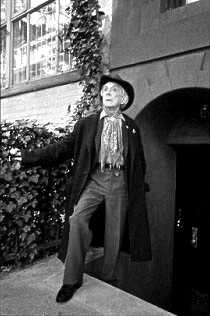 He had been found unconscious and was transported to Manchester Royal Infirmary, where he died, authorities said. He had been found unconscious and was transported to Manchester Royal Infirmary, where he died, authorities said.
Crisp, who lived mainly in New York City for decades, was in his native Britain to begin touring with a one-man show. He was scheduled to perform at the Green Room Theater in Manchester the following night, according the theater�s press manager, Christopher Hodgson.
In an interview published the day before his death in the Times of London, Crisp outlined his wishes for a funeral.
"No flowers. No candles. No long faces standing around in the rain, staring down into a hole in the ground while someone drones on about how wonderful I was. I�d rather just be shuffled off. Just drop me into one of those black plastic bags and leave me by the trash can," Crisp told the newspaper.
A slight, dandified figure who wore makeup and high-heeled shoes and piled his white hair in bouffant waves on top of his head, Crisp made no secret of the fact that he was gay.
Born on Dec. 28, 1908, as Denis Pratt in Sutton, south of London, he worked as a commercial artist, part-time prostitute and art school model after leaving school. He came out in his 20s.
Crisp first stepped into the public arena with his 1968 autobiography, The Naked Civil Servant, later adapted for television. It was widely praised and sold well, but he began to receive anonymous threatening phone calls.
These intensified when the book was made into a film in 1975 with John Hurt as Crisp. His response was to offer the callers an appointment�would Monday at eleven be good?
By now, he was a cult figure-what he called "the mother superior of homosexuality."
In January 1978, his first one-man show opened in London, to great applause.
But he had always wanted to live in America and, three years later, he moved to New York City.
There, he built up a new following, appearing on television, taking his one-man show across the United States, lecturing on cruise ships and appearing in advertisements for Calvin Klein perfume and Levi�s jeans.
He also played Elizabeth I in Sally Potter�s film of Virginia Woolf�s Orlando, and wrote several other books, including How to Become a Virgin and the best-selling New York Diaries.
"The reason I came to America," he said in a 1998 interview with the Sunday Telegraph, "is that I need a constantly changing audience, because I say the same thing over and over again."
He avoided the trappings of fame, living in a small room in Manhattan�s East Village.
His views remained unorthodox. He put off gays and lesbians, for instance, by saying he regarded being gay as an illness.
Associated Press
|