|
 November 19 , 1999 November 19 , 1999
Kentucky lawmakers move to block local rights laws
--Associated Press
November 19, 1999
Frankfort, Ky.--State Rep. Tom Kerr has begun drafting a bill to forbid Kentucky cities and counties from granting legal protections to gays and lesbians, and repeal local civil rights laws that have recently been passed in several cities.
Kerr, a conservative Democrat from Taylor Mill, said he isn't sure he will sponsor the legislation, but even if he doesn't introduce the bill, he's certain someone else will.
Gay civil rights advocates are promising a vigorous fight.
"We'll oppose this effort and any effort to turn the clock backwards on civil rights," said Maria Price, executive director of the Kentucky Fairness Alliance, a statewide lesbian, gay, bisexual and transgender rights group.
Gay civil rights activists have won a string of victories in Kentucky after years of disappointments.
"In order to hold onto a long-held tradition of discrimination, it seems like there are a few folks who want to resort to reactionary efforts to stop what a majority of Kentuckians know is right and fair, which is to oppose discrimination," Price said.
Ordinances forbidding discrimination based on sexual orientation have been enacted this year in Louisville, Lexington, Henderson and Jefferson County. Two of these ordinances also cover gender identity.
Louisville banned discrimination in employment. Lexington, Henderson and Jefferson County outlawed discrimination in employment, housing and public accommodations, such as restaurants and hotels.
Bowling Green, Ky. also is considering similar legislation, but the measure there is expected to fail.
Kerr said he usually defers to local governments to decide what laws are in their best interests, but "the effect of those laws goes far beyond the reaches of the individual cities or the individual counties."
Rep. Joe Fischer, R-Fort Thomas, said he also is considering legislation to ban local gay civil rights laws.
"I think all civil rights legislation should be uniform throughout the state, and there should be no differences depending on which city or county you live in," Fischer said.
Price said she agrees--and that's why Fischer and other legislators should support statewide anti-discrimination laws for gays and lesbians.
A bill already filed by Rep. Kathy Stein, D-Lexington, would prohibit discrimination based on sexual orientation in housing and employment across the state.
Henderson Mayor Joan Hoffman said she is disappointed that state legislators would try to overturn her city's new anti-discrimination law. Hoffman supported the ordinance, which passed in September by a 3-2 vote.
"I truly think it was the right thing to do," she said. "It has only to do with civil rights, human rights. I don't believe our fairness ordinance promotes homosexuality or gives credence to any particular lifestyle, but does just say that in our city everyone has an equal opportunity to work and have a place to live." |

Ashland University opposes gay support group
by Denny Sampson
Gay People's Chronicle
November 19, 1999
Ashland, Ohio--Two students at Ashland University have started a support group for gays, lesbians, bisexuals, and straights, but are receiving opposition from the university.
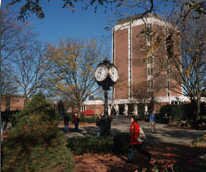 According to Earl Barnett III, co-founder of the newly formed GLBS-Ashland, another group of students tried to get a charter for a support group for Ashland�s GLBT community. However, they were turned down because of the university�s affiliation with the Brethren Church, according to Ashland vice president for student affairs Sue Heimann. According to Earl Barnett III, co-founder of the newly formed GLBS-Ashland, another group of students tried to get a charter for a support group for Ashland�s GLBT community. However, they were turned down because of the university�s affiliation with the Brethren Church, according to Ashland vice president for student affairs Sue Heimann.
The Brethren Church is a conservative Christian faith based in Ashland, with about 14,000 members in 119 congregations.
Heimann said that a "sanctioned group would not be recognized, but individual support for those students would."
"When members of the Brethren heard there might be a gay support group, they called and threatened to cut off financial support if the vice-president approved of the group," said Barnett.
So Barnett decided to start a GLBS support group that would have no affiliation with the university. The group plans to meet weekly, and interact with similar groups from other schools, including University of Akron, Oberlin College, and Kenyon College.
"This will serve as a healthy, open forum where we can talk," said Barnett.
The Collegian, Ashland�s student newspaper, published an article about GLBS-Ashland, written by editor-in-chief Kristy Eckert. She wrote, "The group is not affiliated with AU."
Nevertheless, Barnett received a letter from Director of Student Activities Shirley Foss that said, "Since your group is not sanctioned by the university, it is not entitled to privileges granted to recognized organizations."
In her letter, Foss said that GLBS-Ashland may not use the name Ashland University in any publicity or other areas that would imply that the group is affiliated with the university; meet in campus facilities, except in a person�s residence hall room; post any publicity materials on campus, collect dues of any kind, conduct fundraisers on campus, or produce events on campus without prior authorization by the vice president of student affairs.
"The area is very conservative and very religious," Barnett said. "Ashland University doesn�t tell us about the affiliation with the Brethren until we get here, and then it�s too late. But GLBS-Ashland refers to city of Ashland, not the university." Ashland is about 11 miles northeast of Mansfield.
"We have to work within the structure of this institution," Foss said. "Ashland University is a private, Christian school, founded by the Brethren Church. We are not trying to be discriminatory, we are trying to abide by the guidelines set down by our board of trustees." |
Youth group holds memorial for Chareka Keys
by Denny Sampson
Gay People's Chronicle
November 19, 1999
Cleveland, Ohio--An African-American gay youth group held a memorial service on November 11 for a slain transgender woman at Archwood United Church of Christ.
On the morning of September 27, the body of 19-year-old Chareka Keys of Cleveland was found on the loading dock of an abandoned factory on East 69th St. Police have ruled her death a homicide, although there are currently no known suspects.
Club 1722 Youth Project sponsored the memorial. Club 1722 is a program that was recently established by BlackOut Unlimited to give support to African American gay, bisexual, transgender, and questioning youth.
BlackOut co-founder Larry Webb, who spoke on behalf of Chareka�s brother, said, "There is no closure for Chareka�s family because Chareka�s killer has not been brought to justice. Chareka still isn�t at rest."
"Cases like this are solved because of luck, because of persistence, and because somebody mattered. I am here to say that Chareka mattered," Webb said.
Rev. Carl Wallace of Trinity United Church of Christ delivered the eulogy, in which he said, "Chareka�s soul is at rest. The person whose soul isn�t at rest is the person who killed her."
"We need to continue to let our police departments know that someone�s life has been taken," said police officer Jason Barnett.
Karen Gross, mother of a transgender child and co-founder of the group TransFamily, spoke about her mission to educate others about what it means to be transgender.
"I think of it as lighting the darkened mind," she said. "Once people understand it, they don�t fear it. The biggest fear for transgenders is safety. We need to show society the impact of violence." |
OSU president meets with GLBT student groups
by Miles Rosenberg
November 19, 1999
Columbus, Ohio�Ohio State University administrators are meeting for the first time with lesbian, gay, bisexual and transgender students and groups to find out how they can improve campus life for the students.
 An October 26 panel discussion organized by the Office of Student Gender and Sexuality Services drew close to 100 people to the Ohio Union�s Conference Theatre. An October 26 panel discussion organized by the Office of Student Gender and Sexuality Services drew close to 100 people to the Ohio Union�s Conference Theatre.
The panel, which included Ohio State University president William Kirwan, listened as students spoke about the climate for lesbian, gay, bisexual and transgender students at OSU.
Other panelists included David Williams, vice president of student affairs; Bridget Strathman, Matt Teaman, and Jared Lilly, co-chairs of the Bisexual, Gay and Lesbian Assn. campus group, and Martha Garland, associate dean of academic affairs.
Garland and Kirwan committed themselves to attending "Safe Space," OSU�s training program for heterosexual "allies."
Sile Singleton, coordinator of campus GLBT programs and a panelist, said that the discussion opened up a lot of the panelists� eyes to the quality of life for GLBT students.
"We had a really strong turnout," Singleton said. "Members of Parents and Friends of Lesbians and Gays came, and a mother whose son attended OSU spoke very movingly about him. She explained to the administration that her son is in their hands."
Graduate students spoke about a sometimes unwelcoming classroom climate.
Jenrose Fitzgerald, a master�s candidate in comparative studies, told Kirwan that she had a student evaluate her as a "feminist dyke."
She also emphasized to Kirwan that he needs to become comfortable speaking about GLBT issues.
"The words need to tumble out as easy as �water�," she said.
Some students raised the question of domestic partnership benefits for faculty and university employees, which the Ohio Board of Trustees rejected in 1997. Kirwan promised to try to set up a meeting between P-FLAG and the board of trustees to further discuss this issue.
The October meeting has already begun to initiate change: on Nov. 3, about forty members of B-GALA met informally with the Office of Residence Life to discuss how residence hall directors could serve as allies.
On Nov. 16, Singleton said that the Office of Student Gender and Sexuality Services is currently revising the Safe Space program to encourage participants to confront their own assumptions as they enter the program. Once allies complete the 16-hour, one-year program, they can become facilitators.
Kirwan has a good history of GLBT student advocacy. While president of the University of Maryland, he received an award from the campus GLBT group.
Singleton, who helped organize the panel with Gender and Sexuality Office director Willa Young, said that while change is slow, she saw a lot of positives from the meeting.
"This is the first-ever formal public meeting where the administration has addressed GLBT concerns," she said. "They were there to listen to us."
Mary Daniels, assistant vice president of student affairs, said that this will be the first step in the administration�s efforts to affect the quality of life for gays, lesbians, bisexuals, and transgender students.
"One thing we can do is to provide training and help educate the campus about GLBT issues," she said. "Institutionally, we have a responsibility to create greater understanding of GLBT concerns. With understanding comes acceptance."
Young said that vice president Williams has called for a second meeting for winter quarter. The meeting would be much smaller and involve leadership from GLBT student organizations and other concerned groups.
|